
 We use cookies to give you a better experience. Continue browsing if you accept these terms, or check out our
You’re sitting with a case study assignment on your desk — maybe a company struggling with declining sales, a hospital grappling with communication breakdowns during shift changes, or a classroom facing management challenges. Your professor says, “analyze this case and recommend a solution.” You know you need to do more than summarize what happened. But where do you even start?
Here’s the truth: a case study analysis isn’t a book report. It’s a structured argument that starts with identifying the core problem, evaluates possible solutions using academic frameworks, and ends with a justified recommendation. If you can follow a clear process, you’ll write something that earns top marks — and actually makes sense.
This guide walks you through exactly how to analyze a given case study, step by step, with examples from business, healthcare, and education. You’ll learn when to use SWOT vs. PESTLE vs. Root Cause Analysis, how to avoid the most common student mistakes, and how to structure your paper so your professor sees you’re thinking critically, not just summarizing.
- Case study analysis is NOT the same as writing a case study: One analyzes a professor-given scenario; the other is original research you conduct yourself.
- The 3-phase process is standardized across disciplines: pinpoint the problem, apply a framework, recommend a solution.
- The #1 student mistake — describing symptoms instead of diagnosing root causes — has a simple fix: the “5 Whys” technique.
- Choose frameworks that fit the case, not ones you know by heart. A partially understood but well-matched framework earns better marks than a familiar one forced onto an unmatching scenario.
- What to include: introduction, background, problem statement, analysis, alternative solutions, recommendation, conclusion, and references.
What Is a Case Study Analysis?
A case study analysis is a structured evaluation of a real or hypothetical situation — usually provided by your professor — where you identify key issues, evaluate evidence, and recommend evidence-based solutions.
A case study (the research report genre) is different: it’s an original investigation where you select and study a subject, collect your own data, and produce new knowledge. Your professor assigns you a case to analyze, not a research question to explore.
This distinction matters enormously. Here’s what USC’s Writing Guide emphasizes:
“Confusion often exists between what it means to write a paper that uses a case study research design and writing a paper that analyzes a case; they are two different types of approaches to learning. A case study is a modality of research that investigates a phenomenon for the purpose of creating new knowledge. A case analysis is a pedagogical tool used to teach students how to reflect and think critically about a practical, real-life problem.”(https://libguides.usc.edu/writingguide/assignments/caseanalysis)
In practice, this means:
- Case study = You choose the case, collect data, and write a research report
- Case study analysis = Your professor gives you the case, and you write an analytical response
Case study analysis is predominantly taught in business and economics courses but is widely used across healthcare, education, social sciences, and public administration. The typical word count ranges from 500 to 3,000+ words depending on your discipline and professor’s requirements. APA 7th Edition is the most common citation style.
How to Read a Case Study Like a Pro
Your analysis starts before you write a single sentence. How you read and prepare the case determines the quality of your entire paper.
Step 1: First Reading — Get the Overview
Read the case once quickly. Don’t highlight. Don’t annotate. Just read for comprehension. You’re looking to understand:
- Who are the main characters or stakeholders?
- What organization or setting is this about?
- What’s the general situation?
This first read helps you build a mental model of the scenario. It’s like getting your bearings on a map before you start navigating.
Step 2: Second Reading — Take Detailed Notes
Now read carefully. Highlight key facts, underline problems, and take notes as you go. At this stage, you’re looking for:
- The main issue or conflict
- Key stakeholders and their positions
- Data, facts, and constraints
- Any contradictions or misleading information
USC’s Writing Guide recommends paying particular attention to “identifying individuals, groups, or organizations described in the case and identifying evidence of any problems or issues of concern that impact the situation in a negative way.”(https://libguides.usc.edu/writingguide/assignments/caseanalysis)
Step 3: Stakeholder Mapping
Identify who is affected by the situation and what they want. Write down:
- Each stakeholder’s stated position
- Their underlying concerns
- Any biases or assumptions they’re making
Example: In a business case about declining sales, stakeholders might include the CEO (wants profit growth), the marketing team (wants budget), the sales team (wants better leads), and the customers (want value). Understanding these competing priorities helps you see why the situation is complex.
Monash Student Academic Success notes that “your language expression should be persuasive and user-centred communication” because your stakeholders — the people impacted by your recommendations — have varied needs and perspectives.(https://www.monash.edu/student-academic-success/excel-at-writing/how-to-write/case-study)
Step 4: Look for Misleading Information
Case study scenarios sometimes include false or misleading information designed to test whether you can “sort through conflicting or useless information in order to come up with the preferred solution.”(https://libguides.usc.edu/writingguide/assignments/caseanalysis) Don’t accept every detail at face value. Ask: is this information relevant? Is it contradictory? Does it distract from the core issue?
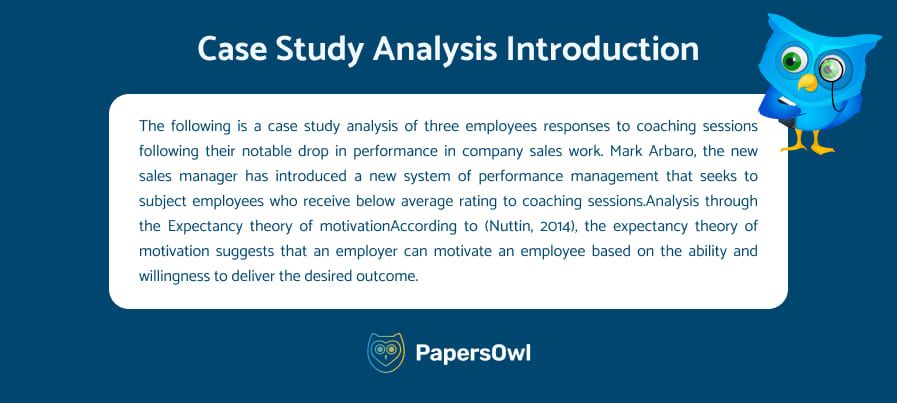
Visual workflow for introducing and reading a case study. Source: David Santana, PapersOwl.
The 3-Step Case Analysis Framework
Once you’ve read and prepared the case, the analysis process follows a standardized three-phase workflow. This structure is consistent whether your case is in business, nursing, education, or social sciences.
Step 1: Pinpoint the Key Problem
Your first job is to identify the core problem — the single most damaging issue within the organizational setting. This is where most students lose marks.
Here’s the critical distinction you need to master:
Symptoms are visible signs of a problem. Root causes are the underlying reasons those symptoms exist.
- Symptom: “Our sales are declining.”
- Root cause: “Our pricing model alienates cost-conscious consumers who represent our primary growth segment.”
The second version identifies the actual problem. The first just describes what’s happening. USC’s Writing Guide is explicit about this distinction: “The purpose of identifying problems is to teach students how to differentiate between problems that vary in severity, impact, and relative importance” and to “discern what the core [i.e., most damaging, detrimental, injurious] problems are.”(https://libguides.usc.edu/writingguide/assignments/caseanalysis)
Step 2: Apply a Framework
This is where your academic knowledge comes in. Analytical frameworks help you organize your thoughts systematically and evaluate the case using relevant theory. You’ll choose a framework based on what actually fits your case (more on framework selection below).
Common frameworks include SWOT analysis, PESTLE analysis, Porter’s Five Forces, and Root Cause Analysis. The key principle from research: don’t force a framework that doesn’t fit your case. A framework applied to the wrong scenario is worse than no framework at all.
Step 3: Recommend a Solution
Your recommendation should emerge logically from your analysis. It needs to be specific enough to implement, realistic given the case context, supported by your analysis and theoretical frameworks, and measurable where possible.
West Coast University’s Writing Guide emphasizes: “Determine and discuss specific strategies for accomplishing the proposed solution. What should be done and who should do it?”(https://westcoastuniversity.edu/online-student-resources/research-and-writing/writing-a-case-study-analysis)
The “5 Whys” Technique
The single most important tool for diagnosing root causes is the “5 Whys” technique. Developed by Toyota as part of their lean manufacturing methodology, this technique is now widely taught in business, healthcare, and education programs because it consistently produces deeper insights than surface-level analysis.
The process is simple:
- State the apparent problem.
- Ask “why does this happen?”
- Keep asking “why?” for each answer — usually five times.
- The final answer is your root cause.
Example: A hospital reports rising patient satisfaction complaints.
- Why? Staff turnover is high.
- Why? Poor workplace culture.
- Why? Inadequate communication.
- Why? No structured feedback system.
- Root cause: Lack of feedback mechanisms.
If you stop at “declining sales” or “staff turnover,” you’re still describing a symptom. The 5 Whys forces you past surface-level observations into the underlying structural issue. TutorBin’s research emphasizes this exact point: “Defining the core problem is like digging beneath surface-level issues to uncover the root cause of the situation. Identify the reason that brings forth the consequences. Then focus on visible symptoms.”(https://tutorbin.com/blog/write-a-case-study-analysis)
How to Use the 5 Whys in Your Analysis Paper
Don’t just state the root cause in one sentence — walk your reader through the diagnostic process. Show each “why” step so your professor can see your reasoning. This demonstrates critical thinking and builds the logical bridge between your problem statement and your recommendations.
The core problem is not that StreamCo lost 20% of its subscribers in 2025 — it's that its pricing model alienates cost-conscious consumers, who represent its primary growth segment. To understand why this pricing model failed, consider the following:

1. Why did StreamCo lose subscribers? → Customers cancelled after promotional periods ended.
2. Why did they cancel? → The post-promotion price was too high for the value they received.
3. Why was the price too high? → StreamCo competed on price but delivered generic content.
4. Why did they offer generic content? → They copied competitors instead of differentiating.
5. **Root cause**: StreamCo failed to build a differentiated content strategy that justifies premium pricing.
Common Analytical Frameworks
Choosing the right framework is one of the most important analytical decisions you’ll make. Here’s a practical comparison of the most commonly used frameworks and when to use each:
SWOT Analysis (Strengths, Weaknesses, Opportunities, Threats)
What it does: Organizes internal factors (strengths and weaknesses) and external factors (opportunities and threats) into a single matrix.
Best for: Strategic planning, organizational evaluation, situations where you need to assess internal capabilities against external conditions.
Not for: Situations where you need to understand market dynamics or macro-economic forces.
PESTLE Analysis (Political, Economic, Social, Technological, Legal, Environmental)
What it does: Examines external macro-environmental factors that impact the case.
Best for: Strategic decisions impacted by external forces — industry regulation, economic trends, demographic shifts, technological disruption.
Not for: Internal organizational problems (use SWOT for those instead).
Porter’s Five Forces
What it does: Analyzes competitive intensity and attractiveness of an industry through five forces: supplier power, buyer power, competitive rivalry, threat of substitution, and threat of new entry.
Best for: Business strategy cases, industry analysis, market positioning decisions.
Not for: Healthcare or education cases where competitive forces are less dominant.
Root Cause Analysis (RCA)
What it does: Systematically identifies the underlying cause of a problem rather than treating symptoms.
Best for: Quality improvement, process failures, healthcare error analysis, situations where symptoms obscure the actual problem.
Not for: Strategic planning where you need a broader picture.
Decision Framework: When to Choose Which
| Situation | Recommended Framework | Why |
|---|---|---|
| Internal organizational issues (culture, structure, performance) | SWOT | Evaluates internal strengths/weaknesses against external conditions |
| External market forces (regulation, economy, technology) | PESTLE | Captures macro-environmental drivers |
| Industry competition and positioning | Porter’s Five Forces | Maps competitive intensity and barriers |
| Process failure or symptom diagnosis | Root Cause Analysis + 5 Whys | Digs beneath surface symptoms |
| Multiple stakeholder conflicts | Stakeholder Mapping + SWOT | Identifies competing interests and their leverage |
PapersOwl emphasizes this principle: “Each format requires different perspectives to analyze, discuss specific strategies, and present key problems. Choose wisely to make your study analysis identify urgent issues.”(https://papersowl.com/blog/how-to-write-a-case-study-analysis)
Case Study Analysis Template
Before you start writing, use this structure. It works across most disciplines and gives your professor a clear roadmap.
1. Introduction (1 paragraph)
- Brief overview of the case
- Context and background
- Thesis statement summarizing your analysis
2. Problem Statement (1 paragraph)
- Clearly define the core problem in one sentence
- Distinguish it from symptoms
- Briefly explain why it matters
3. Analysis (2-3 paragraphs)
- Apply your chosen framework(s)
- Use evidence from the case to support each point
- Connect analysis back to the problem statement
4. Alternative Solutions (1-2 paragraphs)
- Offer 2-3 realistic options
- Briefly evaluate each (pros, cons, feasibility)
- Don’t just list them — compare them
5. Recommendation (1 paragraph)
- Choose the best option
- Justify why it’s superior to alternatives
- Include specific implementation details (who, what, when)
- Anticipate potential obstacles
6. Conclusion (1 paragraph)
- Synthesize your core problem and recommendation
- Connect back to the introduction
- Brief implication or broader significance
Quick Checklist
- [ ] Defined the case clearly?
- [ ] Identified the key problem (not just symptoms)?
- [ ] Applied a framework with evidence from the case?
- [ ] Offered 2-3 realistic alternatives?
- [ ] Chosen the best solution with justification?
- [ ] Set measurable outcomes where possible?
- [ ] Maintained clear structure?
Common Mistakes and How to Avoid Them
Students lose points consistently for these preventable errors. Knowing what to avoid is just as important as knowing what to do.
Mistake 1: Describing Instead of Analyzing
The problem: Writing a paper that simply narrates what happened without applying theoretical frameworks or critical evaluation.
The fix: For every factual statement, ask “why does this matter?” and connect it to a theory or concept from your course. Spend no more than 20% of your paper on background. USC’s Writing Center warns: “Writing is too descriptive. A paper with too much descriptive information detracts from your analysis of the complexities of the case situation.”(https://libguides.usc.edu/writingguide/assignments/caseanalysis)
Mistake 2: Missing the Root Cause
The problem: Identifying symptoms instead of the underlying problem. “Our sales are declining” is a symptom, not a diagnosis.
The fix: Use the 5 Whys technique. Don’t stop at the first level of explanation. Dig deeper until you find the fundamental issue.
Mistake 3: Vague or Unrealistic Recommendations
The problem: Suggesting generic solutions like “improve communication” or “increase awareness” without specifying how, who, or when.
The fix: Make recommendations specific. Name the responsible party, the steps, the timeline, and the metrics for success. USC warns against “indeterminate terminology” and “unrealistic, exaggerated, or unattainable recommendations.”(https://libguides.usc.edu/writingguide/assignments/caseanalysis)
Mistake 4: Ignoring the Rubric
The problem: Failing to read or follow the professor’s grading criteria and assignment instructions.
The fix: Read the brief multiple times. Create a checklist of every requirement. Verify compliance before submitting.
Mistake 5: Weak or Poorly Integrated Evidence
The problem: Dropping quotes or data into the paper without explaining how they support your analysis.
The fix: Use the “ICE framework” (Introduce, Cite, Explain) from our How to Integrate Evidence guide. Every piece of evidence needs context before it and analysis after it.
Discipline-Specific Examples
Here’s how the same framework plays out across three different fields. Notice how the structure stays consistent — the content changes based on discipline.
Business Example: StreamCo’s Subscriber Crisis
Scenario: StreamCo, a mid-tier streaming platform, lost 20% of its subscribers in 2025 due to market saturation and price sensitivity.
Problem Statement: StreamCo’s declining subscriber base stems not from product quality but from an uncompetitive pricing model that alienates cost-conscious consumers — its primary growth segment.
Framework Applied: SWOT + PESTLE analysis to evaluate internal pricing decisions against external market pressures.
Recommendation: Implement a tiered pricing structure with a freemium entry tier and premium content differentiation. This targets both short-term revenue stabilization and long-term brand positioning.
Source: West Coast University’s structured drafting guide and business case methodology(https://westcoastuniversity.edu/online-student-resources/research-and-writing/writing-a-case-study-analysis)
Healthcare Example: Nursing Handoff Communication Breakdown
Scenario: A patient was admitted to a busy hospital ward. During a shift change, a nurse failed to mention the patient’s allergy to a specific antibiotic, and this detail was not written down in the chart either.
Problem Statement: Small errors in verbal and written handoff communication cause major harm in clinical settings — not because nurses are careless, but because the handoff system lacks structure and accountability.
Framework Applied: Root Cause Analysis with the 5 Whys technique to move past “nurse error” to systemic process failure.
Recommendation: Implement a structured handoff sheet with checkboxes for critical information, combined with a read-back protocol where incoming staff verbally confirm key points.
Source: PapersOwl’s detailed healthcare case study example(https://papersowl.com/blog/how-to-write-a-case-study-analysis)
Education Example: Classroom Engagement Challenge
Scenario: A middle school classroom shows declining engagement — students are distracted, submitting incomplete assignments, and participating minimally.
Problem Statement: The classroom management approach relies on compliance rather than engagement, creating a learning environment where students participate only when monitored.
Framework Applied: SWOT analysis combined with educational theory (constructivist learning theory, Bloom’s taxonomy) to evaluate instructional design.
Recommendation: Shift from compliance-based management to inquiry-based learning with choice architecture — giving students structured options in how they demonstrate understanding.
Source: Monash’s discipline-specific approaches for education case studies(https://www.monash.edu/student-academic-success/excel-at-writing/how-to-write/case-study)
Need Help With Your Case Study Analysis?
Writing a case study analysis requires analytical depth, framework application, and clear academic writing. If you’re struggling — especially if you’re new to university-level analysis, an international student navigating academic English, or facing tight deadlines — professional support can make the difference between a passing grade and a high score.
At Place-4-Papers, our qualified writers (each holding a Master’s or PhD) can help you understand how to approach your case study analysis, select strong analytical frameworks, and write a paper that meets your professor’s expectations. Learn more about our academic writing services.
Related Guides
- How to Write a Case Study: Complete Academic Guide — Understand both genres: research report vs. analytical response
- How to Write a Problem-Solution Essay — Similar structure for proposing solutions
- How to Write a Summary and Analysis Essay — Build your analytical skills
- How to Write a Research Question — Strengthen your problem statement
- How to Integrate Evidence in an Essay — Support every claim with proper evidence
- APA 7th Edition Citation Guide — Format your references correctly
Quick FAQ
What is the difference between a case study and a case study analysis?
A case study is an original research report where you select and study a subject, collect your own data, and produce new knowledge. A case study analysis is an assignment where your professor gives you a scenario to analyze — you don’t choose the case or collect new data; you critically evaluate the situation and recommend solutions based on the information provided.
What are the main sections of a case study analysis?
The standard structure is: Introduction → Background → Problem Statement → Analysis (using frameworks) → Alternative Solutions → Recommendation → Conclusion → References. Most professors expect around 5-8 pages with APA formatting.
What frameworks should I use for my case analysis?
Choose frameworks that genuinely fit your case. SWOT for internal organizational issues, PESTLE for external market forces, Porter’s Five Forces for industry competition, and Root Cause Analysis (combined with the 5 Whys) for process failures or symptom diagnosis. See the framework selection table above for a complete comparison.
How do I avoid writing a descriptive summary instead of an analysis?
For every factual statement, ask “why does this matter?” and connect it to theory. Spend no more than 20% of your paper on background and 80% on analysis. Use the “ICE framework” (Introduce, Cite, Explain) from our evidence integration guide to ensure every piece of evidence is properly supported.
What is the 5 Whys technique and how do I use it?
The 5 Whys is a root cause analysis tool where you state the apparent problem and ask “why does this happen?” five times. Each answer becomes the premise for the next “why.” The final answer reveals the underlying root cause, not just the surface symptom. Walk your reader through each step in your paper to demonstrate critical thinking.
The Bottom Line: What Most Students Should Do
Here’s our recommendation: always ask “what’s the root cause?” before writing any analysis section. This single question prevents the vast majority of common mistakes. Most students stop at the first explanation — “the company is losing customers” — and write their paper from there. The students who earn top marks dig one level deeper: “the company is losing customers because its pricing strategy fails to differentiate its offering from competitors.”
The tradeoff most students face is between using a familiar framework and choosing one that genuinely fits. Here’s the truth: better to apply a framework you understand partially than force a framework you know well but that doesn’t match your case. Professors can tell when a framework is being used as a template rather than applied as a genuine analytical tool.
And here’s the warning every student should hear: don’t write a descriptive summary dressed up as analysis. The difference between a B and an A in case analysis is almost always the depth of the root cause diagnosis and the specificity of the recommendations. Use the 5 Whys. Be specific. And always ask why.
Ready to get your case study analysis written? Our team of 210+ expert writers specializes in academic assignments across all disciplines. Order your custom paper today →