
 We use cookies to give you a better experience. Continue browsing if you accept these terms, or check out our
When your professor asks you to write a rhetorical analysis essay, they aren’t asking whether you agree with the topic. They’re asking you to identify how a writer or speaker builds their argument — specifically through three persuasive strategies that have shaped communication for over 2,000 years.
Those strategies are ethos, pathos, and logos.
You’ve probably heard these terms before. Maybe you took a vocabulary quiz on them in high school. Maybe your AP Lang teacher mentioned them in passing. But here’s what most student guides don’t tell you: they’re not just labels you slap onto a text. They’re perspectives — each one revealing a different layer of how persuasion works.
This guide will show you how to identify each appeal like a seasoned reader, how to analyze them with depth, and how to use the Persuasive Trinity framework to make your essay stand out.
- Ethos = the author’s perspective and credibility; Pathos = the audience’s disposition and values; Logos = the text’s structure and reasoning. These are deeper than the standard “credibility, emotion, logic” definitions.
- The Persuasive Trinity — a sequential flow from Ethos → Pathos → Logos — is what separates strong analysis from surface-level labeling. It mirrors how audiences actually process persuasion.
- Appeals overlap and work together in real passages. The best student essays recognize cross-applied examples where all three appeals operate simultaneously.
- When to prioritize each appeal depends on your audience: Ethos for skeptical readers, Pathos for human-centered topics, Logos for evidence-valuing audiences.
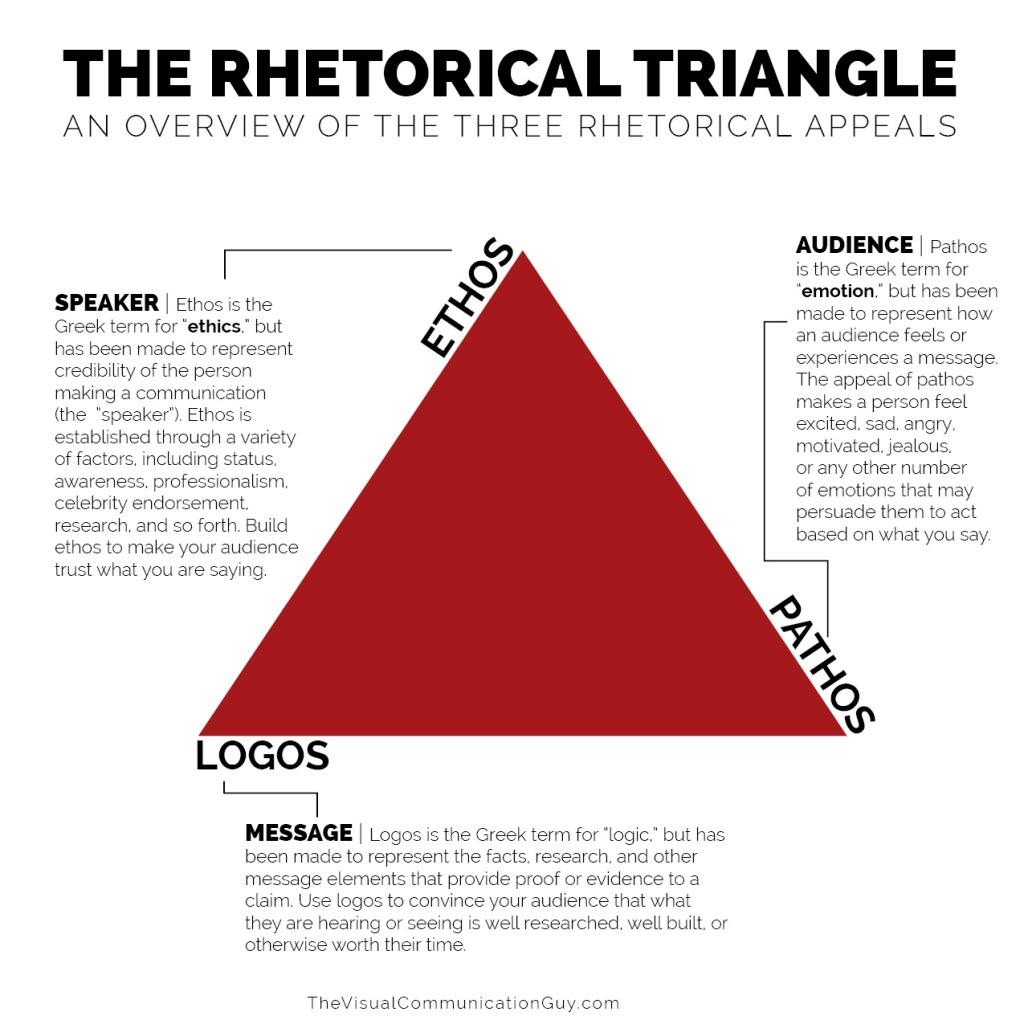
What Are Ethos, Pathos, and Logos? (The Definitions You Actually Need)
The standard definitions are: ethos = credibility, pathos = emotion, logos = logic. They’re accurate, but they’re incomplete. They won’t help you when a passage is doing double duty — establishing credibility and connecting emotionally at the same time.
The Purdue OWL at Purdue University provides the deeper framing that actually helps students write better analysis. Here’s what each appeal really means.
Ethos = The Author’s Perspective
Most guides call ethos “credibility” or “authority.” Purdue OWL reframes it as the author’s perspective more generally. This matters because credibility isn’t just about credentials — it’s about how an author positions themselves, what they stand for, and why an audience should trust their viewpoint.
When you identify ethos, ask: Who is this author speaking as? Not just “what are their credentials?” but “what perspective are they bringing, and why does it matter?”
Example (Lone Star College student essay):
“As a nursing student who has spent over 200 hours volunteering in local emergency rooms, I have witnessed firsthand the systemic delays in patient care.”
This student isn’t just listing credentials. They’re establishing a perspective — someone who has direct, sustained exposure to a problem. That’s ethos in practice.
Pathos = The Audience’s Disposition
Here’s where most students trip up. They call pathos “emotion” and stop there. Purdue OWL explains that pathos is more accurately an appeal to the audience’s disposition — their values, beliefs, and emotional connection to a topic. This is especially important in academic discourse, where emotions aren’t just feelings but intellectual dispositions.
When you identify pathos, ask: What values, fears, or hopes is this author tapping into? Not just “is this emotional?” but “what about the audience’s values does this appeal connect with?”
Example:
“Imagine watching a family member sit in a crowded waiting room for eight hours, in agonizing pain, simply because the triage desk is understaffed.”
This isn’t just “emotional.” It’s tapping into a very specific audience disposition: the fear of inadequate care for someone you love. That’s pathos doing its real work.
Logos = Text Structure and Reasoning
Standard definition: logos = logic or facts. Purdue OWL’s deeper definition: logos is about the structure and content of the text itself — how ideas connect, how evidence supports claims, how reasoning flows from one point to the next.
When you identify logos, ask: How is this argument structured? Not just “what facts are used?” but “how does the reasoning connect?”
Example:
“According to the 2025 Health Department Report, emergency wait times increase by 34% when staffing levels drop below baseline requirements.”
This isn’t just a statistic. It’s a structured logical claim: condition (reduced staffing) → outcome (34% increase in wait times). That structure is what makes logos work.
How to Identify Each Appeal in a Text
Knowing definitions isn’t enough. When you’re analyzing a passage, you need a practical way to spot each appeal. Here’s how.
Spotting Ethos in Real Passages
Ethos often doesn’t announce itself. You have to read between the lines.
- Check credentials and perspective: Does the author establish who they are, what they’ve experienced, or what they stand for?
- Look for fair-mindedness: Does the author acknowledge opposing views? Fair treatment of counterarguments is itself an ethos-building move.
- Notice credible sourcing: Are they citing established institutions, peer-reviewed research, or recognized experts?
- Watch for language choices: Formal register, precise terminology, and careful grammar all build ethos — they signal a writer who takes the topic seriously.
⚠️ Common mistake: Students look for “is the author an expert?” as the only test. But ethos also lives in how a writer handles opposing arguments. A writer who acknowledges a counterargument fairly demonstrates ethos — they’re showing fair-mindedness, not just credentials.
Spotting Pathos in Real Passages
Pathos is more subtle than “this passage is emotional.” It’s about connection.
- Look for individual stories: Does the author use a specific person’s experience to humanize a larger issue?
- Watch for charged language: Words carrying strong connotations — not just “sad” or “angry,” but specific emotional registers like outrage, urgency, or hope.
- Notice shared values: Is the author connecting with something the audience already cares about? Cultural values, national identity, or moral beliefs?
- Ask about disposition: Instead of “what emotion does this evoke?”, ask “what does this tap into about the audience?”
Spotting Logos in Real Passages
Logos is the structural backbone of an argument. Look past the facts to see how the reasoning works.
- Find the logical connections: Does the author show cause and effect? Compare scenarios? Draw analogies?
- Check evidence quality: Are facts properly cited? Are statistics from recognized sources? Is reasoning inductive (specific → general) or deductive (general → specific)?
- Watch for fallacies: Slippery slope arguments, hasty generalizations, circular reasoning — Purdue OWL’s guide on logical fallacies is an excellent reference for spotting weak logos.
- Notice structure: Does the argument build step by step, or does it jump between unrelated points?
The Persuasive Trinity Framework (Your Secret Weapon)
Here’s where this guide gives you something no competitor offers.
The Persuasive Trinity is a framework introduced by Farah Yasser Salama in her November 2025 article on Making Business Matter — and while it was written for business leaders, it applies just as powerfully to student essay analysis.
Most students identify ethos, pathos, and logos without order — like checking three boxes on a list. The Persuasive Trinity teaches that the sequence of appeals matters.
The natural rhythm of persuasion: Ethos → Pathos → Logos
Trust first. Connection second. Clarity last.
Here’s why the order matters:
- Ethos first — When you establish a perspective or build trust, you create the conditions for your audience to listen.
- Pathos second — When you connect emotionally, you make the argument feel personal and relevant.
- Logos third — When you present structured reasoning, you give the audience concrete steps to follow.
This sequence mirrors how humans actually process persuasion. We trust first, feel next, and think last. When your analysis recognizes this pattern in a text — or when you structure your own essay around it — you demonstrate analytical maturity that most student essays miss.
The Persuasive Trinity in Action
Here’s a practical framework you can use when writing your analysis:
“As someone with [Ethos: perspective or experience], I understand how [Pathos: shared value or concern] affects this issue. That is why [Logos: structured reasoning or evidence] supports the argument.”
Adapted for a student essay on healthcare:
“As a healthcare worker who has seen how understaffing affects patient care (Ethos), I understand the fear that families feel when someone they love waits hours for treatment (Pathos). That is why data showing a 34% increase in wait times when staffing drops below baseline (Logos) is so important.”
This framework — trust, connection, clarity — is what separates strong analysis from surface-level labeling. No student guide currently teaches this sequential insight.
Cross-Applied Examples (When All Three Appeals Work Together)
Here’s the reality: real passages rarely use just one appeal. The most effective texts combine all three simultaneously.
The STLCC tutoring resource shows this beautifully with a numbered paragraph where pathos, logos, and ethos overlap. Let’s adapt that approach for a student-friendly example.
Consider this sample passage on student debt:
“I’ve been a financial aid officer at a state university for 15 years, and I’ve watched student debt climb from manageable amounts to life-altering burdens. According to the Federal Reserve’s 2025 report, the average graduate carries $32,400 in student loan debt — a number that research shows delays homeownership by an average of seven years. This isn’t just a statistic. It’s a reality for millions of young people who graduated, worked hard, and are now drowning in interest payments.”
Here’s how all three appeals work together:
- Pathos — “drowning in interest payments” evokes urgency and empathy. The individual story frames a collective problem.
- Logos — “$32,400” and “seven years” are structured data. The Federal Reserve citation adds evidence quality. The cause-and-effect chain (debt → delayed homeownership) is logical reasoning.
- Ethos — “15 years as a financial aid officer” establishes both credentials and a specific perspective. The author isn’t just an expert; they’re someone who has watched this problem unfold.
What makes this passage effective: It doesn’t use one appeal and then move to the next. All three work together in a single paragraph. Your essay should recognize that overlap — not just label each sentence separately, but explain how they reinforce each other.
When to Prioritize Each Appeal (Your Decision Framework)
Not all appeals are equally strong in every situation. Here’s when to prioritize each one.
Prioritize Ethos When
- Your audience is skeptical — If readers doubt your position, start with credibility or perspective before trying to prove anything.
- The topic is controversial — Establishing fair-mindedness and shared values can bridge divides.
- You’re analyzing an author who relies on authority — If the text you’re analyzing is an opinion piece, editorial, or personal essay, ethos is likely central.
Prioritize Pathos When
- The topic is human-centered — Stories of individual suffering, hope, or triumph carry weight in these passages.
- The audience shares a cultural or moral value — When an author connects with something the audience already believes in, pathos does heavy lifting.
- You need to explain why an emotional appeal matters — It’s not just “the author is emotional.” It’s “the author taps into the audience’s fear of loss” or “the author connects with the audience’s hope for progress.”
Prioritize Logos When
- Your audience values evidence — Academic audiences, scientific contexts, and policy debates reward structured reasoning.
- You’re comparing options or making a claim — When you need to prove something specific, logos provides the framework.
- You’re analyzing a data-heavy text — When the passage you’re analyzing relies on statistics, research, or structured arguments, logos is your lens.
| Appeal | Best for | What to Ask |
|---|---|---|
| Ethos | Skeptical audiences, controversial topics, authoritative texts | “Who is this author speaking as, and why should we listen?” |
| Pathos | Human-centered topics, shared values, emotional resonance | “What values, fears, or hopes is this author connecting with?” |
| Logos | Evidence-heavy texts, comparative arguments, academic contexts | “How does the reasoning flow from one point to the next?” |
Common Mistakes Students Make (And How to Avoid Them)
These errors show up in student essays again and again. Here’s what to watch for.
Mistake 1: Labeling Pathos as “Emotional” Without Depth
Most students see a story or vivid imagery and immediately write “pathos.” But pathos isn’t just emotion — it’s audience disposition. Ask yourself: Is the author connecting to something the audience already cares about? If the answer is yes, that’s pathos doing its deeper work.
Mistake 2: Assuming Appeals Are Mutually Exclusive
This is the biggest gap in student analysis. Passages use ethos, pathos, and logos simultaneously. The STLCC example (above) proves it — one paragraph, three appeals working together. Your essay should recognize overlaps, not treat appeals as separate boxes.
Mistake 3: Leading With Logos When the Audience Isn’t Connected
The Persuasive Trinity warns against this: presenting structured reasoning (logos) before establishing trust (ethos) or connection (pathos) often fails. When you analyze a text that leads with data and never builds audience connection first, that’s a structural weakness worth noting.
Mistake 4: Missing the Author’s Perspective in Ethos
Ethos isn’t just credentials. It’s perspective. If an author is writing as a student, a parent, a worker, or a citizen — that’s ethos. It’s their positioning in the argument. Don’t just look for titles or degrees.
Mistake 5: Ignoring the Rhetorical Context
A passage’s appeal to ethos, pathos, or logos depends heavily on when and where it was written. A text from 1963 looks different when read through a 2026 lens. Always consider the rhetorical situation — context, audience, and purpose — before labeling an appeal.
Putting It All Together: Your Analysis Checklist
Before you submit your rhetorical analysis essay, run through these questions:
- [ ] Did I identify each appeal? Ethos, pathos, and logos — not just the standard definitions, but the deeper perspectives?
- [ ] Did I recognize overlaps? Did I explain how appeals work together, not just separately?
- [ ] Did I notice the sequence? Does the text follow a Persuasive Trinity rhythm (trust → connection → clarity)?
- [ ] Did I connect to the audience? Did I explain what the appeal connects with, not just that it connects?
- [ ] Did I use evidence? Every claim about a rhetorical strategy should be backed by a specific passage.
Why This Matters for Your Essay
Understanding ethos, pathos, and logos deeply isn’t just about scoring well on one assignment. It’s a transferable skill. Every piece of writing you read — news articles, opinion pieces, speeches, advertisements — uses these three appeals. Recognizing them means you’re not just reading; you’re analyzing.
And when your professor sees you recognizing the Persuasive Trinity — understanding that the order of appeals matters, not just their presence — that’s the kind of insight that separates strong essays from average ones.
What’s Next?
Now that you understand how to identify and analyze the three core appeals, the next step is putting them into essay structure.
For the full essay framework — the SOAPST analysis method, PEEL paragraph structure, thesis statement formula, and common mistakes to avoid — check our companion guide: How to Write a Rhetorical Analysis Essay: Step-by-Step Guide. That article covers the complete writing process. This guide covered the analytical foundations. Together, they give you everything you need.
Key Sources and Further Reading
This article draws on authoritative academic writing resources. Here are the primary sources you can consult for deeper study:
- Purdue OWL — Rhetorical Strategies: The definitive guide on ethos, pathos, and logos with detailed student examples, definitions of inductive/deductive reasoning, and a comprehensive list of logical fallacies.
- Purdue OWL — Aristotle’s Rhetorical Situation: Explains the deeper meanings of ethos (author perspective), pathos (audience perspective), and logos (text structure) beyond standard definitions.
- Making Business Matter — The Hidden Power Behind How Leaders Win Hearts and Minds (Nov 2025, Farah Yasser Salama): Introduces the Persuasive Trinity framework (Ethos → Pathos → Logos sequential order).
- STLCC Tutoring Resource — Pathos, Logos and Ethos (Sept 2025): Provides a sample paragraph with numbered annotations showing how all three appeals work together in a single passage.
- Lone Star College LibGuide — Rhetorical Appeals (May 2026): Updated student-friendly examples for each appeal with an explicit focus on student essay writing.
- Visual Communication Guy — The Rhetorical Triangle: Clean, authoritative diagram of the three appeals with labeled connections.
Final Thoughts
Ethos, pathos, and logos are more than vocabulary words. They’re perspectives — three lenses through which you can analyze any text. When you understand what they really mean, when you recognize how they overlap, and when you see the Persuasive Trinity at work, you’re not just reading. You’re analyzing.
And that’s exactly what your professor wants.
Looking for custom help with your rhetorical analysis essay? Our team of qualified academic writers can walk through your assigned text step by step. Order your custom rhetorical analysis essay now.
Related Guides