
 We use cookies to give you a better experience. Continue browsing if you accept these terms, or check out our
What Is a College Reflection Paper?
A reflection paper is first-person academic writing that connects your personal experience to your learning. It’s not a summary essay (which just recounts what happened) and it’s not an opinion piece (which says what you liked or disliked). It sits somewhere in between — a structured exploration of why your experience matters.
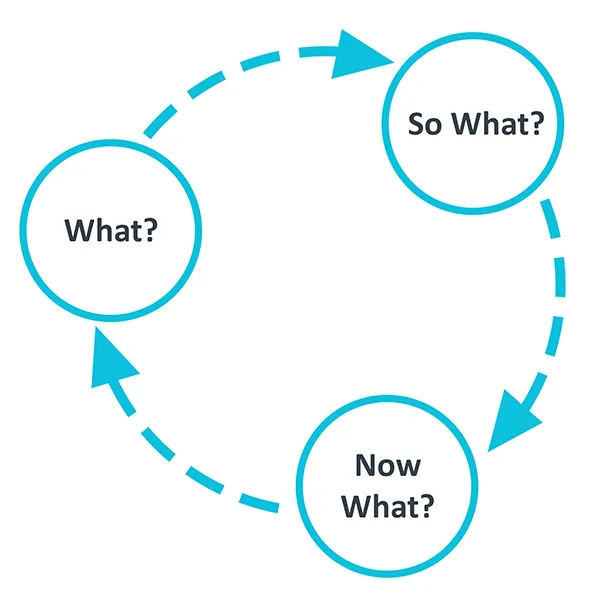
- What? — Describe the experience factually. What happened? Who was involved? What did you do?
- So What? — Analyze what it means. Connect the experience to theory, explore your feelings, and identify patterns.
- Now What? — Plan action. What will you do differently next time? Make it specific, measurable, and time-bound.
Think of it like this:
- Summary = “What happened.”
- Opinion = “How I felt about it.”
- Reflection = “Why it matters, what I learned, and how I’ll change.”
That’s the core distinction. Most college reflection assignments expect you to analyze your experience through a structured framework — not just narrate events and leave it at that.
The What? So What? Now What? framework is the most commonly taught model in university writing guides and AI Overviews because it’s simple enough to remember, flexible enough for any discipline, and forces you past surface description into genuine analysis.
Here’s what I’d recommend: use the What? So What? Now What? framework for most college reflection papers. It’s faster, more actionable, and directly answers what professors are asking for — without the length and emotional depth that Gibbs’ six-stage cycle requires (unless your assignment specifically calls for it).
The What? So What? Now What? Framework Explained
The framework consists of three interconnected stages, each building on the previous one. The stages are cyclical — each one feeds into the next — but they’re presented linearly so you can write through them in order.
Stage 1: What? — Describe the Experience
Purpose: Set the scene. Give your reader enough context to understand the experience you’re reflecting on — without jumping into analysis yet.
The “What?” stage establishes a clear, factual account of the experience. It’s the foundation for everything that follows.
Guiding Questions:
- What happened?
- What was the context or setting?
- Who was involved?
- What was my role?
- What was the outcome?
- What worked well, and what didn’t?
What to Include:
- A concise factual account of the event
- Key participants and their roles
- The setting and timeframe
- Specific actions you took
What NOT to Include:
- Analysis of why things happened (save for “So What?”)
- Feelings or emotions (save for “So What?” — or include only briefly)
- Theory or literature references (save for “So What?”)
- Overly detailed backstory
Example — College Group Project:
“During my second year of a Business Communications course, I was assigned to a four-person group project that accounted for 40% of our final grade. Our task was to analyze a local small business’s marketing strategy and present findings in front of the entire class. I volunteered as the team leader, and the initial meeting went poorly — two members missed it entirely, and we had no agreed-upon division of labor.”
💡 Share-Worthy Insight — The “Depth Ladder” Framework:
Think of reflection on four levels:
- Descriptive — “What happened?” (no analysis)
- Responsive — “This was interesting because…” (superficial)
- Reflective — “I learned that X influences Y” (moderate)
- Transformative — “My assumption about X was wrong, and now I understand why” (deep, high-marking)
If your “So What?” stage sits at Level 1 or 2, you will be capped at a lower grade band. Aim for Levels 3–4.
Stage 2: So What? — Analyze the Meaning
Purpose: Make sense of the “What?” by exploring your emotional responses, connecting the experience to prior knowledge, identifying patterns, and uncovering implications.
This is the make-or-break section of your reflection paper. It’s where you move from telling a story to analyzing it.
Guiding Questions:
- What does this tell me about myself, my attitudes, or my practice?
- What was going through my mind during the situation?
- What assumptions or prior experiences influenced my reactions?
- What theory, course concept, or literature helps explain what occurred?
- What is my new understanding of the situation?
- What patterns or themes emerge?
What to Include:
- At least one theoretical framework or academic concept
- Analysis of why specific events or decisions occurred
- Evidence of genuine critical thinking (not just summary)
- Clear connection between theory and your personal experience
- Recognition of how emotions shaped your decisions
What NOT to Include:
- New factual description (save for “What?”)
- Action plans (save for “Now What?”)
- Theory without linking it to your experience
- Vague observations (“this was a challenging experience”)
Example — Connecting Group Conflict to Team Leadership Theory:
“The conflict in our group project can be understood through Tuckman’s (1965) stages of group development: forming, storming, norming, and performing. Our project was stuck in the ‘storming’ phase — two members disagreed fundamentally on the analytical approach, and I handled it by assigning tasks rather than facilitating dialogue. This aligns with research suggesting that inexperienced team leaders tend toward directive leadership under stress (Hackman, 2003). The breakthrough happened only when I shifted to a collaborative approach, which moved us into ‘norming.’ This confirms that my preference for top-down decision-making was inhibiting team cohesion.”
⚠️ Critical Nuance: Edinburgh’s Reflection Toolkit warns that the model “does not achieve a meaningful and critical depth” if students just answer three questions mechanically. Use the guiding questions as prompts, not as fill-in-the-blank exercises. Dig deeper. Ask “why?” multiple times. Connect to theory. That’s where the real analysis lives.
Stage 3: Now What? — Plan Action
Purpose: Translate insights into concrete, measurable next steps. This is your forward-looking plan — the part that shows you can apply your reflection to future practice.
The “Now What?” stage is where reflection becomes action. It’s not enough to say “I’ll do better next time.” You need specific, realistic commitments.
Guiding Questions:
- What will I do differently in a similar situation?
- What specific steps will I take?
- How will I measure progress?
- What resources or support do I need?
- What is my timeline?
What to Include:
- Specific actions (not general intentions)
- Measurable indicators of progress
- A realistic timeline
- Accountability mechanisms
What NOT to Include:
- Vague commitments (“I’ll improve my skills”)
- Unrealistic promises (“I’ll be the best leader everyone has ever seen”)
- New theoretical references
Example — SMART Action Plan:
SMART Action Plan:
- Specific: I will use a task-tracking app to plan my weekly study schedule every Sunday evening.
- Measurable: I will log at least four study sessions per week and review completion rates on Sundays.
- Achievable: I already have a weekly timetable and the app is free.
- Relevant: Poor time management was the root cause of the stress in my group project.
- Time-bound: I will maintain this habit for six weeks and reassess my productivity by the end of the semester.
Step-by-Step: Writing Each Section
Now that you understand the three stages, here’s how to apply them to a complete reflection paper.
Introduction (The “What?” Bridge)
Your intro should hook the reader with the experience and end with a thesis statement that previews your key insight.
Structure:
- Hook — A brief description of the experience or a provocative question
- Context — Who, what, when, where (2–3 sentences)
- Thesis — Your key insight (the “so what” previewed in one sentence)
Example:
“I never thought a single group meeting could reveal so much about my leadership style. During my second-year Business Communications course, I led a four-person team through a marketing analysis project — and our rocky start taught me more about collaboration than any textbook ever could.”
Body Paragraphs (The “So What?” Deep-Dive)
This is where you unpack the meaning. Organize it around patterns, themes, or theory connections — not chronologically.
Structure:
- Theme 1 — What the experience taught you about yourself
- Theme 2 — How it connects to course concepts or theory
- Theme 3 — What it reveals about broader patterns in your behavior or thinking
Word Allocation: ~60–70% of your total essay. This is the heart of your reflection.
Conclusion (The “Now What?” Takeaway)
Your conclusion should synthesize your learning and point toward future action.
Structure:
- Summary — Briefly recap your key insight
- Action — What you’ll do differently next time
- Forward-looking — How this changes your approach going forward
Example:
“I learned that I tend to default to directive leadership under pressure, which I now understand is counterproductive. In the future, I can anticipate group conflict by establishing communication norms from the first meeting. The broader lesson is that leadership isn’t about taking control — it’s about creating the conditions for collaboration.”
Gibbs vs. What? So What? Now What? — When to Use Which
Both models are widely used in college reflection assignments. But they serve different purposes. Here’s how to decide which one fits your assignment:
| Feature | What? So What? Now What? | Gibbs’ Reflective Cycle |
|---|---|---|
| Origin | Terry Borton (1970) | Graham Gibbs (1988) |
| Stages | 3 | 6 |
| Structure | Linear, straightforward | Cyclical, comprehensive |
| Best for | Quick learning points, routine events, short assignments | Emotionally significant events, complex situations, detailed analysis |
| Tone | Action-oriented, practical | Detailed, emotionally thorough |
| Typical length | Short (3 paragraphs, 500–1,000 words) | Longer (6 stages, 1,000–3,000 words) |
| Assignment types | General college reflection, quick learning points, journal entries | Nursing clinicals, education practicums, emotionally heavy events, advanced courses |
| Emotional depth | Implicit (included in “So What?”) | Explicit dedicated “Feelings” stage |
| When to choose | When your assignment is short, when the event is routine, or when you need a fast practical model | When the event was emotionally significant, when your rubric requires detailed analysis, or when your discipline prefers Gibbs (nursing, education) |
Common Mistakes Students Make (and How to Fix Them)
Here’s what people get wrong about reflection papers — and what to do instead.
This section draws on Monash University’s annotated examples of common errors in reflective writing. Each mistake shows the original text and how to fix it.
Mistake 1: Writing Too Informally
Why it fails: Reflective writing is based on your experience, but it’s still academic writing. Using casual language undermines your credibility.
“In my opinion, if there are too many ‘buts’ in my choosing to practice in a rural area then I must not be ready for it, so it’s better for me to stay put in the city.”
“The reservations I currently feel about practising in a rural setting suggest that I am not yet ready for such a move. Therefore, at this stage I plan to work in the city on graduation.”
Mistake 2: Describing Without Analyzing
Why it fails: You need to analyze and evaluate the thinking processes involved — not just recount events. The reader needs enough detail to understand context, but the analysis is where the learning lives.
“During the second week of my clinical study, I met a patient who needed an x-ray for her knee and hip joint. She was overweight and not very aware of my role as radiographer – she treated me more like a technician than a future practitioner. **Even worse**, she was not cooperative, kept murmuring and shouted out about her pain throughout the procedure.”
“During the second week of my clinical study, I met a patient who needed an x-ray for her knee and hip joint. This was made more difficult because she was significantly overweight and not very aware of my role as radiographer. She appeared distracted and had difficulty coping with her level of pain, sometimes shouting out. What surprised me most was the attitude of the patient to health professionals. In my culture, most people treat health professionals with great respect; in the Australian context, compliance cannot be assumed. I found that talking quietly and explaining each requirement in detail reassured her and led to greater cooperation — but it made the consultation much longer than it otherwise would have been.”
Mistake 3: Moralizing About Behavior
Why it fails: Judging other people’s actions is not reflection — it’s opinion. Reflection should focus on your own learning, not on criticizing others.
“I was shocked when the doctor showed me the patient’s file without seeking consent. His disregard for the rules regarding patient consent caused me to lose respect for him and to question his ethical standards.”
“I was surprised when the doctor showed me the patient’s file without seeking consent. It made me realise that discrepancies can exist between what is taught on course and the way in which medicine is practised in reality. From my own perspective, as a future doctor I would seek to maintain high ethical standards, and to encourage that among staff under my supervision.”
Mistake 4: Using Judgmental Language
Why it fails: Words like “even worse,” “shouted out,” or “disregard” inject judgment into what should be an objective description. Neutral descriptions preserve credibility.
Fix: Replace judgmental adjectives and adverbs with neutral, factual language. Instead of “even worse,” use “compounding the difficulty.” Instead of “shouted out,” use “voiced concerns loudly.”
Mistake 5: Wandering Without Structure
Why it fails: Reflection that drifts without direction feels like journaling, not academic writing. Students should focus on what was most significant and relate it to course concepts and future career.
Fix: Before you start writing, pick one or two themes. Map them to the What? So What? Now What? framework. If your reflection wanders, you’ve lost your thesis.
Reflection Paper Template
Here’s a practical fill-in-the-blank template you can use immediately. Copy it, fill in the brackets, and you have a complete reflection paper outline.
Introduction
Hook: “[Describe the experience in 1–2 sentences. What was the moment that matters?]”
Context: “This experience took place during [course/event/setting] in [month/year]. I was [your role], and [brief context about who else was involved].”
Thesis: “Reflecting on this experience, I learned that [your key insight in one sentence].”
Body Paragraph 1: What?
“What happened was [describe the event factually]. Specifically, [key actions you took, who was involved, what the outcome was]. Looking back, [one sentence acknowledging what worked and what didn’t].”
Body Paragraph 2: So What?
“What this experience taught me is [your insight]. I think this matters because [connect to course concept, theory, or broader pattern]. For example, [specific example that supports your insight]. Research on [topic] suggests that [brief theory connection].”
Body Paragraph 3: So What? (Deeper Analysis)
“Another layer I hadn’t considered until now is [deeper insight]. This connects to [another concept or pattern]. In the past, I assumed that [old assumption], but now I see that [new understanding].”
Conclusion: Now What?
“Going forward, I will [specific action]. To make sure I follow through, I will [measurable step]. Over the next [timeframe], I plan to [timeline-bound commitment]. This experience has changed how I think about [broader theme].”
Reflection Paper Example
Here’s a complete worked example showing the framework in action. This is a realistic college-level reflection on a group project experience.
Example: Reflection on a Group Project
Introduction
“I never thought a single group meeting could reveal so much about my leadership style. During my second-year Business Communications course, I led a four-person team through a marketing analysis project — and our rocky start taught me more about collaboration than any textbook ever could.”
What?
“During my second year of a Business Communications course, I was assigned to a four-person group project that accounted for 40% of our final grade. Our task was to analyze a local small business’s marketing strategy and present findings in front of the entire class. I volunteered as the team leader, and the initial meeting went poorly — two members missed it entirely, and we had no agreed-upon division of labor. When the remaining two members and I tried to assign tasks, we ended up arguing about who should do what. The meeting lasted 90 minutes, and we accomplished nothing.”
So What?
“What this experience taught me is that I default to directive leadership under pressure — and that it doesn’t work. In the moment, I assumed that taking charge was the fastest way to move forward. But I was wrong. The conflict in our group project can be understood through Tuckman’s (1965) stages of group development: forming, storming, norming, and performing. Our project was stuck in the ‘storming’ phase — two members disagreed fundamentally on the analytical approach, and I handled it by assigning tasks rather than facilitating dialogue. This aligns with research suggesting that inexperienced team leaders tend toward directive leadership under stress (Hackman, 2003). The breakthrough happened only when I shifted to a collaborative approach in week three, asking each member to choose their preferred tasks. Team morale improved noticeably, and our final presentation received positive feedback from the instructor.”
Now What?
“Going forward, I will establish communication norms from the first team meeting instead of jumping straight into task assignment. To make sure I follow through, I will draft a team charter that outlines expectations for participation, decision-making, and conflict resolution. Over the next semester, I will practice this approach in every group assignment. This experience has changed how I think about leadership — it’s not about taking control. It’s about creating the conditions for collaboration.”
Summary + Next Steps
The What? So What? Now What? framework is the simplest, most actionable model for writing college reflection papers. It’s fast enough for short assignments, flexible enough for any discipline, and forces you past surface description into genuine analysis.
Key takeaways:
- What? — Describe the experience factually (15–20% of your essay).
- So What? — Analyze the meaning, connect to theory, explore patterns (60–70%).
- Now What? — Plan specific, measurable action (15–20%).
Before you submit, check:
- ✅ Your “So What?” stage includes at least one theory or course concept
- ✅ Your “Now What?” stage has specific, measurable commitments (not “I’ll do better”)
- ✅ You’re using academic tone, not casual language
- ✅ You’re analyzing yourself, not moralizing about others
- ✅ Your reflection operates at Level 3 or 4 on the Depth Ladder (not just Level 1–2)
FAQ
What is the format of a reflection paper?
A reflection paper follows a standard structure: introduction (hook, context, thesis), body paragraphs (description, analysis, connection to theory), and conclusion (summary, future action). Most are 500–1,000 words. APA format is commonly required.
Can I use “I” in a reflection paper?
Yes! Reflection papers are first-person academic writing. Using “I” is expected. The key is balancing personal voice with academic credibility.
What is the difference between Gibbs and What? So What? Now What?
Gibbs has six stages and includes a dedicated “Feelings” stage, making it better for emotionally significant events. What? So What? Now What? has three stages and is faster and more action-oriented, making it better for routine learning points and short assignments.
How long should a reflection paper be?
Most are 500–1,000 words, though requirements vary by professor. The What? So What? Now What? framework fits naturally into this range.
What is the What? So What? Now What? framework?
It’s a three-stage reflective model originated by Terry Borton (1970) and formalized by Rolfe, Freshwater, and Jasper (2001). The three stages are: What? (describe the experience), So What? (analyze the meaning), and Now What? (plan action).