
 We use cookies to give you a better experience. Continue browsing if you accept these terms, or check out our
Your citation passes the DOI check, so it looks real. But then you open the paper and the title is wrong, the author’s specialty is completely unrelated, and the claim you cited doesn’t even exist in that paper. Frankenstein citations are AI-generated references that stitch together real pieces (a real author, a real journal, even a valid DOI format) with fake pieces (a fabricated title, incorrect metadata, unsupported claims). Unlike completely fake references, these slip past the one check most students rely on.
- A Frankenstein citation mixes real and fabricated elements, making it harder to catch than completely fake references.
- The danger lies in the DOI trap: when a DOI resolves, students assume the entire citation is valid. It isn’t.
- Real cases range from a $5,000 court fine to 100+ papers at top AI conferences containing fabricated references.
- After training, 66 students could only correctly categorize 2 or fewer of 4 AI references. Awareness alone isn’t enough.
- The fix is simple but non-negotiable: resolve the DOI, search the title, and verify the claim, separately and in order.
What Is a “Frankenstein Citation” Anyway?
The term comes from Mary Shelley’s Frankenstein, the story of a monster stitched together from body parts, brought to life but never quite right. That’s exactly what these partially wrong AI citations look like.
The term was formally established by Elena Kuleshova at the Global Fact-Checking Network in June 2025 [1] and is now used across six+ authoritative sources including Nature, Checkmark Plagiarism, and Tufts Library.
The distinction matters. A completely fabricated citation has every element invented (fake author, fake journal, fake title). A Frankenstein citation is worse because it passes the easy check: the DOI resolves, the journal name looks real, the author exists. But the title doesn’t match the paper, or the author never wrote on that topic, or the claim you cited just doesn’t appear in the article.
It’s the difference between “this reference is totally fake” and “this reference looks perfect until I read the abstract.”
In 2022, Furman University professor Darren Hick went viral when a student’s essay on David Hume contained quotes from non-existent authors and publications [1:1]. The student had used an AI tool that hallucinated an entire bibliography.
Citation Red Flag Rubric
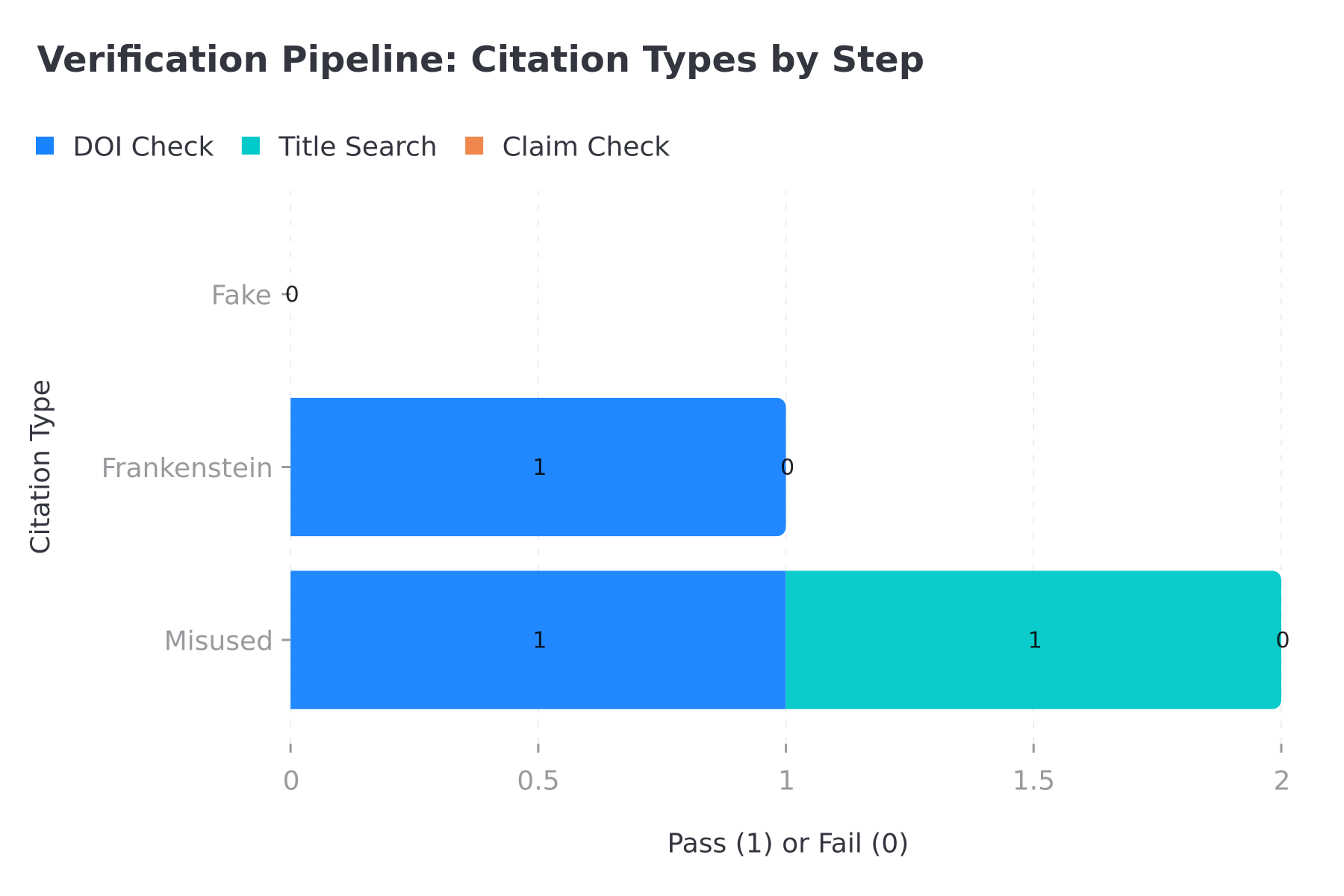
The three types of bad citations behave very differently across the verification pipeline. Understanding which type you’re dealing with determines what goes wrong.
| Verification Step | Completely Fabricated | Frankenstein (Partially Wrong) | Misused Source |
|---|---|---|---|
| DOI check | ❌ Fails (404 / not found) | ✅ Passes (DOI resolves) | ✅ Passes (DOI resolves) |
| Title search (Google Scholar, CrossRef) | ❌ No result | ❌ Title mismatch or no exact match | ✅ Exact match found |
| Author verification (profile/publications) | ❌ Author doesn’t exist or wrong field | ⚠️ Author exists but doesn’t work on this topic | ✅ Author is the real author |
| Claim support check (read abstract/full text) | ❌ N/A (no paper) | ❌ Paper doesn’t support the claim | ❌ Paper doesn’t support the claim |
Here’s why this matters: the Frankenstein citation is the most dangerous type because it passes the DOI check (the step students use 90% of the time) and then creates false confidence. You think you’re safe, but two steps deeper and everything falls apart. The misused source is sneakier still: all the metadata is correct, but the paper doesn’t actually support what you’re citing it for.
The “Uncanny Valley” of AI Citations: Why They’re So Dangerous
When you paste an AI-generated citation into your paper and the DOI resolves to a real publisher page, you feel relieved. You did the work. You verified it.
But here’s what most students miss: a resolved DOI proves only that something exists at that address. It doesn’t prove the citation you wrote is correct.
The verification pipeline should have three steps:
- Resolve the DOI. Go to
doi.organd paste the identifier. If it resolves to a real paper, move to step two. - Compare the metadata. Check the title, authors, year, and journal. Even if the DOI resolves, the metadata might belong to a completely different paper — often called “composite metadata” where AI assembles parts from multiple real records.
- Verify the claim. Read the abstract and ask: does this paper actually support the claim I’m making? AI frequently cites real papers for claims they never made, and this is the hardest verification step.
The Frankenstein citation trips you up at step two (the DOI resolves, but the metadata is wrong). The misused source trips you up at step three (everything matches, but the paper doesn’t support your claim).
The Verification Breakdown
When you’re working with partially wrong AI references instead of completely fake ones, the stakes are higher because your confidence is already raised by the DOI check. That false sense of security is exactly what makes these AI hallucinated citations so insidious.
That’s why Kevin from Unflag calls it the “Frankenstein citation phenomenon” [2]: AI doesn’t invent random gibberish. It recombines real entities. A real professor paired with a real journal and an invented title. Every component looks legitimate individually. Together, they form a phantom.
Real Case Studies: When Frankenstein Citations Made It Into Print
The consequences of Frankenstein citations extend far beyond an error message.
Peer Review Doesn’t Catch Them
ACL 2026 NeurIPS Conference. Over 100 of 200 accepted papers contained fabricated references: 35 fully fabricated, 64 with significant errors, and only 77 out of 176 references accurate [3]. Domain experts who tried to avoid fake citations still missed them. This isn’t a student-only problem — it affects how even trained professionals distinguish between fake vs partially correct citations under pressure.
Legal, Professional, and Academic Consequences
Mata v. Avianca. Attorney Steven Schwartz filed a legal brief citing six ChatGPT-generated precedents. Judge P. Kevin Castel found not a single one existed, fined him $5,000, and wrote: “the submission of fictitious judicial decisions undermines the very foundation of justice.”
Elsevier Retraction. Elsevier retracted multiple publications in Resources Policy after discovering AI-generated references with real author names but non-existent titles. Not a single entry could be confirmed [1:2].
The “Citation Loop” Phenomenon. Once a partially wrong citation passes peer review, it enters the scholarly record. Future AI models scrape these papers, ingest the errors, and regurgitate them as fact. Computer scientist Guillaume Cabanac learned this firsthand when Google Scholar notified him that a fabricated paper in International Dental Journal cited his research (he was being cited for work he never did) [4].
How Many Students Fall for This? The Data
The awareness gap is real, and the numbers are sobering.
A 2024 Springer peer-reviewed study tested 66 undergraduate students [5] on their ability to evaluate AI-generated references. The setup was straightforward: students watched a short instructional video about ChatGPT citation hallucinations, then used a worksheet to categorize four references as “correct,” “partially correct,” or “hallucination.”
The result? Most students could only correctly categorize 2 or fewer of the 4 references. Training was insufficient. They understood the concept of hallucinations, but couldn’t detect them in practice.
The data behind that failure:
| Metric | Finding |
|---|---|
| References generated by ChatGPT | 50 total across 3 versions |
| Hallucinations (completely non-existent) | 52% |
| References that existed | 48% (24 of 50) |
| Average completeness score of existing references | 2.17 out of 6 |
| Student reference categorization accuracy | Mean of 1.76 correct (out of 4) |
Even the existing references were mostly useless: of the 15 existing unique references, 7 were coded as “not at all relevant” to the research topic, 5 as “possibly relevant,” and only 3 as “definitely yes.”
The takeaway isn’t that students are careless. It’s that Frankenstein citations are designed to fool you. AI recombines real entities so convincingly that even trained students struggle to separate the wheat from the phantom.
How to Spot a Frankenstein Citation (Step-by-Step)
This five-step verification protocol adapts the checklist from LitSource and Unflag into a practical workflow you can follow in under five minutes per citation [6].
Step 1: Resolve the DOI
Go directly to doi.org and paste the identifier. Don’t trust hyperlinks embedded in your draft (they can redirect you to the wrong paper). If the DOI resolves to a different title or shows “Not Found,” you’ve caught a fabricated or mismatched citation.
Step 2: Search the exact title
Search the article title in quotation marks on Google Scholar and CrossRef. Example: "Prefrontal Cortex Activation Deficits in Acute Sleep Deprivation". If no exact match appears, the citation is fabricated. This catches Frankenstein citations where the AI invented a plausible-sounding title.
Step 3: Verify the author’s publication record
Check the author’s Google Scholar profile, ORCID page, or institution website. Confirm they actually study the discipline mentioned in the citation. A psychology professor cited for a neuroscience paper is a red flag (the AI likely combined a real author from an adjacent field).
Beyond the Basics: What Students Usually Miss
Step 4: Check journal volume, issue, and pages
If the paper appears to exist, open the journal archive and find the claimed volume and issue. Check the table of contents. If the pages are occupied by an unrelated paper, the citation is composite metadata (fabricated by AI).
Step 5: Read the abstract to verify the claim
This is the step most people skip, and it’s the most important. Find the real paper (or confirm it doesn’t exist) and read the abstract. Does the paper actually support the claim you’re making? AI frequently attributes specific statistics or conclusions to real papers that never made those claims.
Beyond the Basics: Claim Verification Is the Hardest Step
Citing a paper for something it doesn’t say is “misused source” (the citation is real, but the claim is not supported). This is why reading the abstract, or the full text for important claims, should be your final checkpoint.
What to Do If You’ve Already Cited a Frankenstein Reference
You discover a cited source after submission — here’s what to do:
- Identify the core claim the fake citation was supporting. What factual statement did it back up?
- Search for the actual source using that claim in Google Scholar, PubMed, or your library database. Find the real paper that contains that data.
- Replace the citation with the genuine reference, properly formatted.
- Re-read the surrounding text to make sure your sentence accurately reflects the real study’s methodology, not the AI’s generic summary.
Here’s what I’d recommend: don’t just delete the citation. Find the real source, verify it, and replace it. If you can’t find a real source for the claim, revise or remove the claim entirely. Citing a Frankenstein reference isn’t grounds for panic. It’s grounds for fixing it before anyone else reads your work.